The Indonesian labor movement has historically been repressed and shaped by militarism. Throughout the Old Order and New Order eras, economic expansion and national stability were the main reasons behind the labor movement repression and depoliticization of civil society.
One of the first attempts to keep a tight rein on labor movements in Indonesia was the establishment of the Labor-Military Cooperation Board/Badan Kerja Sama Buruh dan Militer (BKS-BUMIL) in 1957. Military personnel began to dominate managerial positions in nationalized companies through BKS-BUMIL, which compelled the anti-strike regulation.
To keep the protests at bay, President Soekarno issued Presidential Determination No. 7/1963 that prohibits strikes and lockouts in vital companies, government departments, and agencies followed by Presidential Decree No. 123/196. It took the government 27 years to revoke these haphazard regulations through Presidential Decree No. 27/1990.
The repression of the labor movement reached its peak in the New Order Era. The Central All-Indonesian Workers Organization/Sentral Organisasi Buruh Seluruh Indonesia (SOBSI) along with 62 other labor unions, which was considered affiliated with the Communist Party of Indonesia/Partai Komunis Indonesia (PKI), disbanded by the ruling regime via the Decision No. 85/KOGAM/1966 signed by Lieutenant General Soeharto.
Furthermore, the New Order regime forced all labor unions to join the sole umbrella organization All-Indonesian Workers’ Union/Federasi Buruh Seluruh Indonesia (FBSI), which changed to Serikat Pekerja Seluruh Indonesia (SPSI). Within this era, The Ministry of Labor also changed its name to The Ministry of Manpower.
The use of “manpower” instead of “labor” indicates the attempt to depoliticize the labor movement, which was believed to be associated with the communist ideology and potentially trigger class struggle. In the New Order era, May Day was restricted through Presidential Decree No. 148/1968 which revoked 1 May as a holiday specified in Presidential Decree No. 251/1967. The regime constantly tries to restrict the public’s political awareness to have the upper hand.
Ministerial Decree 4/Men/1986, issued by the New Order regime, prohibited the right to strike and organize labor unions. Ministerial Decree 342/Men/1986 also provided for additional military engagement, allowing the military to interfere in labor disputes through the Korem (Military Resort Command), Kodim (Military District Command), and Kodam (Military Regional Command).
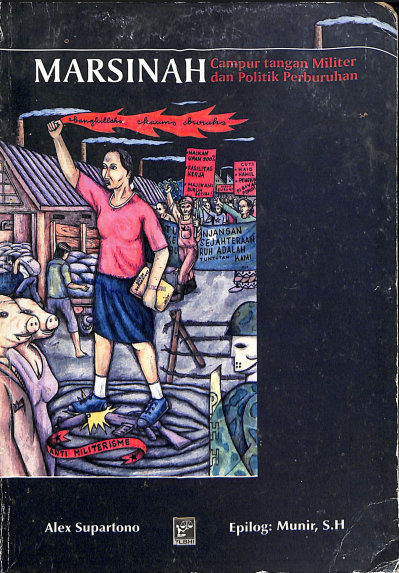
The murder of Marsinah at the end of the New Order era shows that using militarism to settle labor disputes always ends in violence. On May 3–4, 1993, Marsinah, a worker of PT Catur Putra Surya, organized a labor union strike. On May 5, 1993, PT Catur Surya and military personnel summoned at least 13 employees to the Military District Command/Kodim 0816 Sidoarjo and had them resign. Marsinah was last seen alive at 21.30 on 5 May 1993, returning from the Kodim, and was discovered dead on 8 May 1993.
According to forensic expert Dr. Mun’im Idries’ examination, Marsinah died from a gunshot wound, supporting the theory that military personnel, who had access to firearms, killed her. An independent investigation led by the Indonesian Legal Aid Foundation/Yayasan Lembaga Bantuan Hukum Indonesia (YLBHI) discovered numerous anomalies throughout the investigation of the Marsinah murder case.
History shows that the ruling regime has consistently used the military power to repress labor movements.
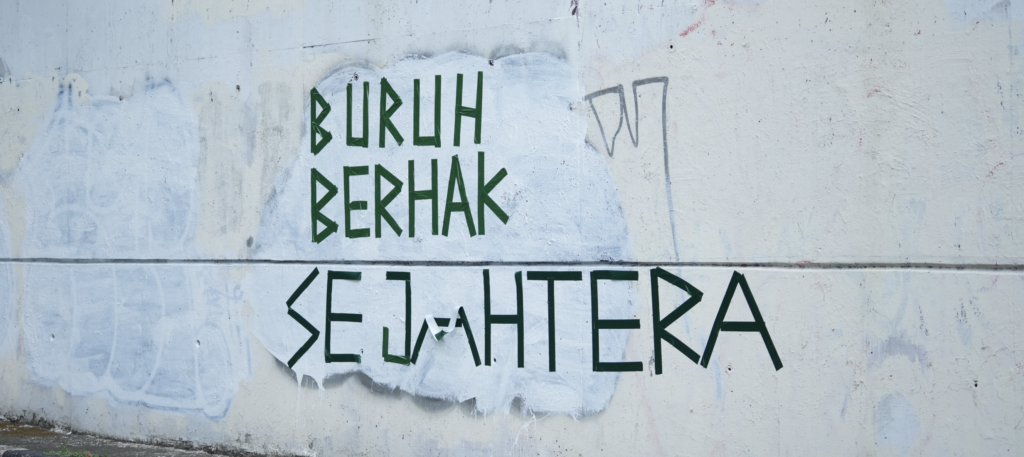
After the 1998 Reform, the dismissal of Military’s (ABRI) dual-function and the enactment of the Law No. 34/2004 on the Indonesian National Armed Forces (UU TNI) did not cancel out the military involvement in private and government sectors. Instead of focusing on national defense, TNI became even more involved in politics, governments, and business. The change of article on UU TNI that expanded the scope of military involvement in civil positions affirms the phenomenon of the military’s threat towards labor welfare.
Not only that they are being deployed in a civil programs such as National Strategic Projects (PSN), Merah-Putih Cooperative (Koperasi Desa Merah Putih), Food Estate in Merauke, and the Nutritious Meal Program (MBG), the military also involved in strategic positions as the Director of Bulog, PT Agrinas, PT Timah, and other state-owned companies.
As for example, TNI was involved in supervising PT Duta Palma plantation in West Kalimantan which was then followed by the acquisition of the company by PT Agrinas Palma Nusantara. PT Agrinas Palma Nusantara is a state-owned company that was formed from PT Indra Karya whose job is to manage Palm Oil plantations confiscated by the Forest Area Enforcement Taskforce (Satgas PKH).
This company was formed from PT Agro Industri Nasional, which was established by a foundation under the Ministry of Defense when Prabowo was the minister. The leaders consist of retired military generals such as Letjen Pur. Agus Sutomo (Director) and Letjen Pur. R. Wisnoe Prasetja Boedi (Commissioner).
According to YLBHI’s report, there are 36 MoU between the TNI with ministries and ministerial-level agencies and local governments, covering the infrastructure sectors and educational sectors. Military powers in the executive sectors also can be seen by seeing 11 ministers and vice ministers with military background in the current cabinet (Merah Putih Cabinet). The pattern of the militarisation which happened 70 years ago is being implemented in today’s regime.
In 2025, YLBHI and all 18 LBH office branches all over Indonesia noted that labor issues became the most reported case by the civil society which led to a total number of 190 cases being reported. These cases are impacted by the labor system which is infused with neoliberalism’s pattern being pushed by Government Regulations (PP) No. 78/2015 about Wage, up to the Omnibus Law on Job Creation from the government’s initiative. LBH-YLBHI also noted that there were at least 2005 cases of layoffs affecting laborers in 2024-2025. When it rains, it pours.
The labor welfare has undoubtedly declined as remilitarization increased.
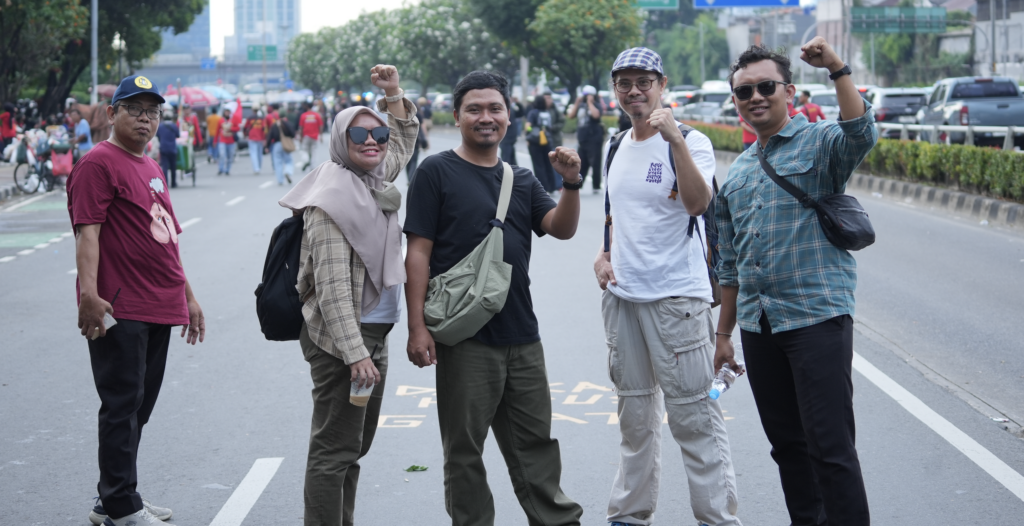
Faced with the uncertainty of the laws which are unbiased towards labor, the representatives (DPR RI) in fact, roll out the red carpet for militarism. Starting from passing the revision of the TNI Law related to the expansions of military role in civil sectors, up to allowing the involvement of TNI massively in civil programs such as MBG and Merah Putih Cooperative.
The TNI’s involvement in civilian affairs should be subject to monitoring by legislative entities at different levels. For instance, it is undemocratic to exclude local administrations, schools, teachers, and parents from the MBG project. Without the use of military force and the absence of legislative monitoring, this program—which significantly strains the state budget—would not have been feasible.
In contrast to the dual-function era, Indonesia is now in the “Multi-Function TNI” era, which may be more dominating. The TNI’s defensive responsibilities have expanded to civil and economic issues. This expansion proceeded without meaningful public participation, democratic political decisions, and parliamentary opposition.
Allowing multi-function TNI practices to continue poses a threat to democracy. Involving military personnel in civilian affairs clearly undermines TNI professionalism, weakens democratic institutions, and supports the rise of authoritarianism.
__________________
This Op-Ed was written by Muhamad Isnur, Chairperson of YLBHI, and has been published on The Jakarta Post, 29 May 2026, under the same title.